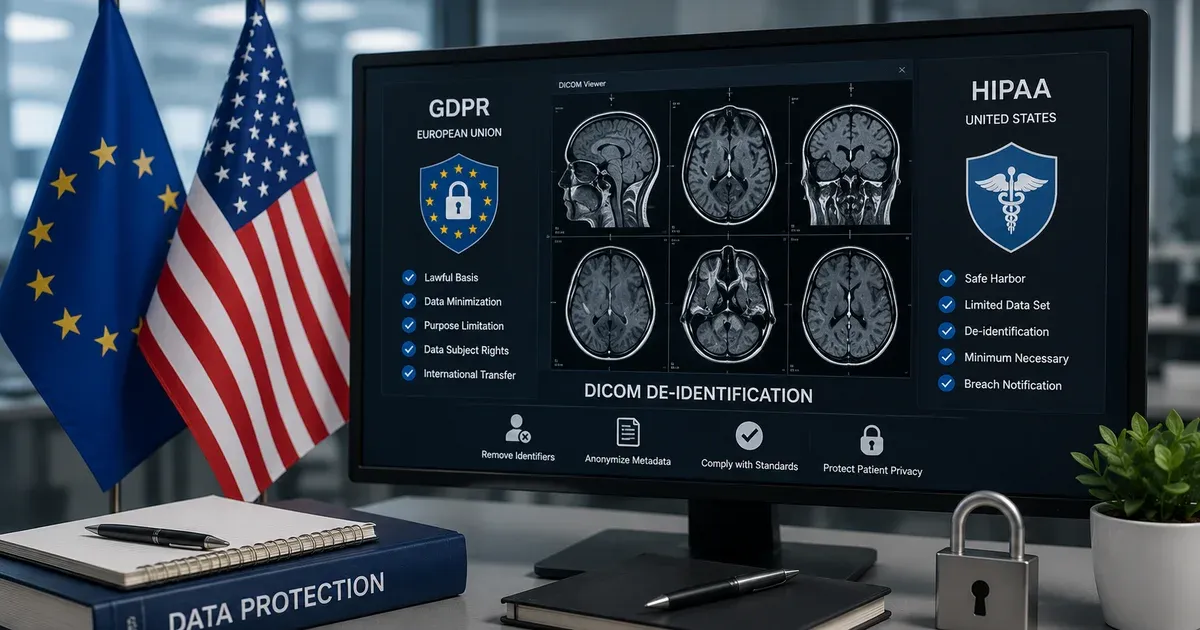
Introduction: The International Challenge of Medical Image Privacy
Medical imaging datasets are among the most valuable resources in modern biomedical research. Multi-site clinical trials, AI model training, cross-border collaborative studies, and open-access teaching archives all require sharing DICOM files beyond the institution where they were originally acquired. But every DICOM file carries patient-identifiable information embedded in dozens of metadata tags — and the regulatory frameworks governing how that information must be handled differ significantly depending on where the data originates and where it will be used.
For researchers, data managers, and healthcare IT professionals working on international projects, two regulatory frameworks dominate: the United States' Health Insurance Portability and Accountability Act (HIPAA) and the European Union's General Data Protection Regulation (GDPR). While both aim to protect patient privacy, their approaches, definitions, and practical requirements differ in important ways that directly affect how you must de-identify DICOM files.
This guide provides a detailed comparison of GDPR and HIPAA requirements as they apply to DICOM medical image anonymization, highlights the key practical differences, and shows how to build a de-identification workflow that satisfies both frameworks simultaneously — a necessity when datasets span U.S. and EU sites. You can use our free online DICOM De-Identifier to apply these principles to your own files.
HIPAA Requirements for DICOM De-Identification
Under HIPAA, medical imaging data is considered Protected Health Information (PHI) when it can be used to identify an individual. The Privacy Rule provides two methods for creating de-identified data that is no longer regulated as PHI.
Method 1: Safe Harbor
The Safe Harbor method requires removing or suppressing 18 specific categories of identifiers listed in the Privacy Rule. For DICOM images, these categories map to dozens of metadata tags. The 18 Safe Harbor identifier categories include:
- Names (Patient Name, Referring Physician Name, etc.)
- Geographic data smaller than state level (addresses, zip codes except the first three digits if the geographic unit contains more than 20,000 people)
- All dates except year (birth dates, admission dates, discharge dates, and any dates of service)
- Phone numbers
- Fax numbers
- Email addresses
- Social security numbers
- Medical record numbers
- Health plan beneficiary numbers
- Account numbers
- Certificate or license numbers
- Vehicle identifiers and serial numbers
- Device identifiers and serial numbers (scanner serial numbers in DICOM)
- Web URLs
- IP addresses
- Biometric identifiers (fingerprints, voiceprints)
- Full-face photographs and any comparable images
- Any other unique identifying number, characteristic, or code
After removing all 18 categories, the covered entity must have no actual knowledge that the remaining information could be used alone or in combination to identify an individual. The key advantage of Safe Harbor is its predictability — if you remove the 18 categories, you are deemed compliant without requiring statistical analysis.
Method 2: Expert Determination
Expert Determination allows a qualified statistician to certify that the risk of re-identification is "very small." This method provides more flexibility — for example, it may allow retention of some dates or certain geographic details — but requires documented statistical analysis and may not satisfy institutional review boards (IRBs) that require Safe Harbor for specific research protocols.
GDPR Requirements for DICOM Image Anonymization
The GDPR takes a fundamentally different approach. Medical data is designated as a special category of personal data under Article 9, subject to stricter processing conditions than ordinary personal data. The key Article 9 grounds for processing medical images for research include:
- Explicit consent (Art. 9(2)(a)): The data subject has given explicit consent specifically for the research purpose.
- Scientific research purposes (Art. 9(2)(j)): Processing is necessary for scientific or historical research or statistical purposes, subject to appropriate safeguards under Article 89(1).
- Public interest (Art. 9(2)(g)): Processing is necessary for reasons of substantial public interest in areas like public health.
Crucially, unlike HIPAA's Safe Harbor method, the GDPR does not provide a categorical list of identifiers whose removal guarantees compliance. Instead, it defines anonymization as irreversible: data is anonymous under GDPR only when it cannot reasonably be used — by the controller or any other person — to identify the natural person, taking into account all means reasonably likely to be used, such as singling out, linkage, and inference.
Pseudonymization — replacing direct identifiers with pseudonyms while retaining a re-identification key — is explicitly recognized in the GDPR as a risk-reduction technique (Recital 28, Art. 4(5)), but pseudonymized data remains personal data and continues to be subject to GDPR. True anonymization, which eliminates any reasonable re-identification risk, takes data outside the GDPR scope entirely.
Key Differences: GDPR vs HIPAA for DICOM Files
1. Definition of Anonymization
HIPAA's Safe Harbor provides a bright-line rule: remove the 18 categories and you have de-identified data. GDPR has no equivalent checklist — it requires a context-sensitive risk assessment. A dataset that is anonymous under HIPAA Safe Harbor may still be personal data under GDPR if re-identification is reasonably possible using other available information (for example, a regional patient registry that could be linked to imaging data).
2. Dates and Ages
HIPAA Safe Harbor requires removing all dates of service except year, and requires removing ages over 89 (replacing with "90+" to prevent re-identification of elderly patients from rare age-procedure combinations). GDPR imposes no specific rule on dates, but the context-specific risk assessment may require removing dates if they could contribute to re-identification in a linked dataset. For multi-site European research, the conservative approach is to treat dates as HIPAA does.
3. Device Identifiers and UIDs
HIPAA Safe Harbor requires removing device identifiers and serial numbers — which in DICOM includes Equipment Serial Number (0018,1000), Station Name (0008,1010), and similar tags. GDPR does not explicitly list these, but if a scanner is operated by a single physician whose identity could be inferred from the device data, the device identifier may contribute to indirect identification and should be removed or replaced.
DICOM UIDs — Study Instance UID, Series Instance UID, SOP Instance UID — are unique identifiers. Under both HIPAA and GDPR, UIDs should be replaced with newly generated values for de-identified datasets. A database containing DICOM UIDs linked to patient records is sufficient to re-identify any image.
4. Consent Requirements
Under HIPAA, researchers can often proceed without individual patient consent when the IRB grants a waiver of authorization for research using de-identified data. GDPR requires a legal basis for processing even before anonymization occurs. If you are collecting images from EU patients for a research dataset, you must establish a valid legal basis (explicit consent, legitimate interest, or public interest under Art. 9(2)) for the initial collection, regardless of whether you subsequently anonymize the data.
5. Right to Erasure
The GDPR provides data subjects with a right to erasure ("right to be forgotten") under Article 17. Once data is truly anonymized, the right to erasure no longer applies because the anonymized data is no longer personal data. However, if you are using pseudonymization (retaining re-identification keys), data subjects may request erasure and you must be able to locate and delete their data. HIPAA does not provide an equivalent patient right to request deletion of research data once properly de-identified.
6. Data Minimization
The GDPR's data minimization principle (Art. 5(1)(c)) requires that only the personal data that is necessary for the specified purpose be collected and retained. Applied to DICOM images, this means retaining only the metadata tags necessary for the research purpose and removing all others. HIPAA focuses on removing the 18 identifier categories but does not impose the same affirmative data minimization obligation on non-identifying metadata.

Practical DICOM Tag Removal Matrix
For compliance with both HIPAA Safe Harbor and GDPR, the following DICOM tag categories should typically be handled as indicated:
- Patient demographics (Patient Name, ID, Birthdate, Sex, Age, Weight, Address): Remove or replace under both frameworks.
- Study and acquisition dates (Study Date, Series Date, Acquisition Date, Content Date): Remove day/month under HIPAA; apply risk assessment under GDPR (typically also remove for EU datasets).
- Physician and operator names (Referring Physician, Performing Physician, Operators Name): Remove under HIPAA; remove under GDPR to prevent indirect identification of referring clinician and thus institution.
- Institution identifiers (Institution Name, Institution Address, Station Name): Remove under HIPAA; assess under GDPR — if institution is very small or specialized, it may allow patient re-identification through linkage.
- Device identifiers (Equipment Serial Number, Manufacturer Model Name): Remove serial number under HIPAA; assess manufacturer/model under GDPR.
- UIDs (Study, Series, SOP Instance UIDs, Referenced UIDs in all sequences): Replace with newly generated UIDs under both frameworks.
- Accession Number, Medical Record Number: Remove under both frameworks.
- Burned-in annotations: Require special handling — OCR detection and pixel region redaction for visible text overlaid on image data.
- Private tags: Remove all private tags by default unless their content is verified to contain no patient-identifiable information.
Multi-Site International Research: Combining Both Frameworks
When a research project collects images from both U.S. and EU sites, the safest approach is to satisfy both frameworks simultaneously by applying the stricter elements of each:
- Apply HIPAA Safe Harbor as the baseline: Remove all 18 identifier categories. This handles the U.S. side and most of the EU side.
- Apply GDPR risk assessment on top: Review what data remains after Safe Harbor removal and assess whether it could reasonably enable re-identification in the context of available European datasets (national patient registries, rare disease cohorts, etc.).
- Establish legal bases before collection: For EU participant data, document the GDPR legal basis (typically explicit consent or a research ethics approval covering Art. 9(2)(j)) before any DICOM files are collected.
- Replace UIDs consistently: Generate new UIDs using a deterministic mapping if longitudinal linkage of imaging series within a patient is needed, or random UIDs if cross-study linkage is not required.
- Audit burned-in annotations separately: Pixel-level de-identification for face photos (dermoscopy, fundus), ocular images, and X-rays with patient name overlaid requires specialized tools beyond standard tag stripping.
- Document your process: Both HIPAA (documentation of de-identification method) and GDPR (records of processing activities under Art. 30) require documented evidence of the de-identification procedures applied.
Limitations and Complementary Measures
Tag-level de-identification removes metadata identifiers but does not address all re-identification vectors in DICOM images:
- Burned-in annotations: Patient name and ID are often rendered directly into the pixel data of portable X-rays, computed radiography images, and some ultrasound studies. These require pixel-level redaction using image analysis tools.
- Face photographs: Dermoscopy, fundus photography, facial dermatology, and 3D CT volume renderings of the head can expose facial features. DICOM PS 3.15 Annex E recommends removing or masking facial regions in these modalities.
- Rare conditions and small cohorts: Even after Safe Harbor de-identification, a dataset consisting entirely of patients with a specific rare disease treated at a single facility may allow re-identification through quasi-identifier linkage. Expert Determination or additional data transformation (date shifting, age generalization) is warranted.
- Structured reports and SR objects: DICOM Structured Reports (SR) and DICOM SR measurements can contain dictated text with patient names, referring providers, and clinical context. These require separate review and de-identification.
Using Our DICOM De-Identifier
Our free DICOM De-Identifier allows you to apply tag-level de-identification directly in your browser, with no data ever transmitted to a server. It supports removal of the key HIPAA Safe Harbor identifier categories and generation of replacement UIDs. For full GDPR compliance, we recommend reviewing the remaining tags after de-identification using our DICOM Tag Viewer to confirm no residual identifying information remains, particularly in private tags and structured report sequences.
For production-scale datasets requiring complete audit trails and regulatory documentation, consider integrating the DICOM PS 3.15 Annex E de-identification profiles into your PACS or research data management pipeline, complemented by institutional review of your de-identification procedures by a qualified privacy officer or data protection officer (DPO).
Conclusion
HIPAA and GDPR share a common goal — protecting patient privacy — but they achieve it through different mechanisms. HIPAA's Safe Harbor provides a clear checklist that can be applied predictably at scale. GDPR requires a continuous risk-based assessment that considers the broader context of available data and the rights of European data subjects. For international research involving DICOM images from both regions, a combined approach — HIPAA Safe Harbor as baseline, supplemented by GDPR data minimization and context-aware risk assessment — provides the most defensible compliance position. Investing in proper de-identification workflows protects patients, reduces institutional liability, and ensures that valuable imaging datasets can be shared responsibly to advance medical science.