
Introduction: Why ADT Mapping Deserves Its Own Design Guide
ADT messages are the operational heartbeat of most hospital integration environments. Every admission, discharge, transfer, registration update, merge, and demographic correction tends to produce an HL7 v2.x ADT event, and downstream systems use those events to decide who the patient is, whether the visit is active, where the patient is located, and which identifiers should anchor the chart. That makes ADT mapping one of the most sensitive parts of any modernization program that moves from legacy HL7 interfaces to FHIR APIs.
At first glance the task seems straightforward: take patient fields from PID, take visit fields from PV1, and build FHIR resources. In practice, production ADT feeds contain multiple identifiers, repeated names, site-specific location conventions, variable trigger event semantics, and visit lifecycle rules that rarely fit a simplistic one-row-to-one-resource approach. If you want to inspect message structure before writing transformation logic, use our HL7 Viewer. If you want to test field mappings directly, the HL7 v2 to FHIR Mapper is the fastest way to validate assumptions against synthetic or de-identified samples.
This guide focuses narrowly on ADT to FHIR Patient and Encounter mapping. It complements our broader HL7 v2 to FHIR migration guide and pairs naturally with our companion article on mapping ORU messages to DiagnosticReport and Observation. The goal here is operational clarity: which fields usually matter, how trigger events affect Encounter state, where teams lose information, and what validations prevent downstream identity and visit errors.
Start with the Correct Mental Model
An HL7 ADT message is not a database record. It is an event notification containing enough state for a receiving system to update its own representation of a patient and visit. The message may be authoritative for demographics, partially authoritative for location, and only conditionally authoritative for class, financial identifiers, or attending provider depending on the source application. FHIR resources, by contrast, model those same concepts as reusable resources that may live independently and be referenced across workflows.
That means your mapper must answer three design questions before any field-level transformation begins. First, which resource owns each business fact: Patient, Encounter, Coverage, Organization, Location, Practitioner, or an extension? Second, is the ADT event creating a new state, updating an existing one, or signaling a status transition? Third, which identifiers and references let the receiving FHIR server correlate incoming data with existing resources safely? Teams that skip these questions often ship a mapper that is syntactically correct but semantically unstable.
How ADT Trigger Events Influence FHIR State
Not all ADT events should be treated equally. ADT^A01 and ADT^A04 commonly create or activate an Encounter. ADT^A08 usually updates demographics without changing the visit lifecycle. ADT^A02 may indicate a transfer that affects Encounter.location and sometimes service class. ADT^A03 usually closes the encounter period. ADT^A11 and A13 reverse previous admit or discharge actions and therefore need either status rollback logic or a compensating update strategy in your receiving system.
FHIR does not have one status value per HL7 trigger event. Instead, you derive resource state from business meaning. A01 and A04 often map to Encounter.status = in-progress. A03 often maps to finished with period.end populated from PV1-45. A08 may leave the Encounter status unchanged while still updating Patient identifiers, name, telecom, or address. If your feed includes pre-admit events such as A05, you may choose planned until the formal admission is received.
The practical rule is simple: never let the event code alone overwrite a richer downstream state without considering visit context. For example, a late-arriving A08 after discharge should probably update Patient demographics but should not reopen a finished Encounter unless your site has explicitly defined that behavior.
PID Segment to FHIR Patient
The PID segment is the core demographic payload. The most important field is usually PID-3, Patient Identifier List. Because PID-3 repeats, each repetition should be evaluated, not flattened. One repetition may be the enterprise MRN, another a local facility MRN, another the national identifier, another an old chart number. In FHIR, each becomes an element in Patient.identifier[] with a reliable system, optional type, and the raw identifier value in value.
Most failed ADT-to-FHIR projects break on identifier system modeling rather than on string parsing. If the assigning authority from CX.4 is present, map it consistently to a canonical naming system URI. If the interface only sends local text such as HOSPITAL or REG, build a maintained lookup table instead of copying those strings directly into identifier.system. Consistency matters more than elegance because patient matching, merge handling, and search depend on stable systems.
PID-5 maps to Patient.name. The XPN datatype can hold family name, given name, second names, prefixes, suffixes, and name type code. Preserve the primary name as official where appropriate. If the source sends alias or maiden names in repetitions, map them as additional HumanName entries instead of losing them. This becomes important when downstream patient portals or MPI workflows need alternate searchability.
PID-7 is usually mapped to Patient.birthDate, and PID-8 to Patient.gender. Keep this mapping conservative. Administrative sex in HL7 v2 is not a full representation of sex or gender identity, so it should not be expanded beyond the source meaning. PID-11 becomes one or more Patient.address elements, PID-13 and PID-14 become Patient.telecom, and PID-16, PID-22, or PID-29 may require local policy decisions depending on whether your target FHIR profile supports or expects those elements.
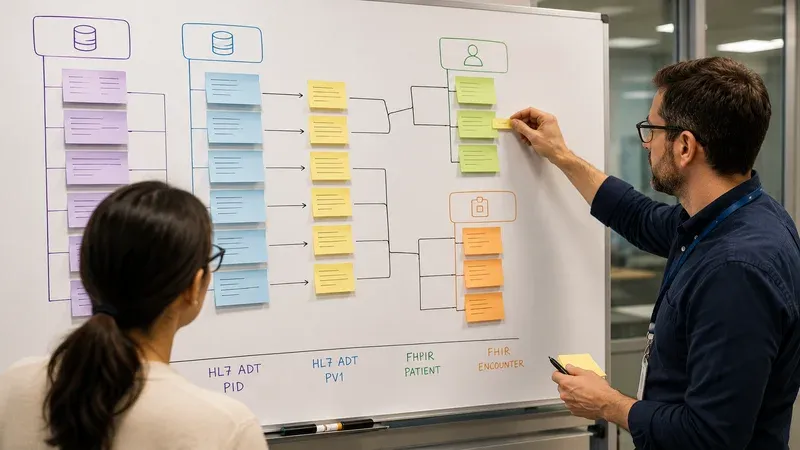
PV1 Segment to FHIR Encounter
PV1 is where the visit state lives, but it rarely arrives in perfectly normalized form. PV1-2 patient class drives Encounter.class, but hospitals often overload class and level-of-care concepts across multiple downstream systems. Build a documented translation table from local classes to the FHIR coding you intend to support. A mapper that simply copies local text without a controlled vocabulary usually becomes impossible to query later.
PV1-3 assigned patient location is another high-risk field. The PL datatype can contain point of care, room, bed, facility, status, and building details. FHIR Encounter.location can reference a Location resource, but many pipelines initially populate a display string because the Location master data does not yet exist. That is acceptable as a staged design, but teams should decide early whether they are building reference integrity or just human-readable output. If you want long-term interoperability, create resolvable Location resources instead of emitting opaque text only.
PV1-7 attending doctor, PV1-8 referring doctor, and PV1-9 consulting doctor can all become Encounter participants, but only if you define how provider identifiers map to Practitioner or PractitionerRole resources. This is the same architectural issue as patient identifiers: the parser is easy; the business identity model is not. When source feeds only send name text and not stable provider identifiers, be careful about auto-creating duplicate practitioners in the target repository.
PV1-19 visit number typically maps to Encounter.identifier and is often the most important visit correlation key. PV1-44 and PV1-45 map naturally to Encounter.period.start and Encounter.period.end. If you receive transfers or service changes mid-visit, update the same Encounter unless the site defines separate financial or clinical encounters requiring resource splitting.
Common Mapping Patterns for A01, A03, A04, and A08
For ADT^A01, create or update Patient and create or activate Encounter. For ADT^A04, create Patient and Encounter for an outpatient or registration workflow, usually with ambulatory class. For ADT^A03, do not create a new Encounter. Instead, locate the current visit by identifier, populate the end period if missing, and transition status to finished. For ADT^A08, update Patient fields first and then selectively update Encounter only if visit-related fields changed.
Notice that this is correlation logic, not pure transformation. A robust FHIR mapper must search or index existing resources by identifier before deciding whether it is performing create versus update semantics. If you only emit collection bundles without deduplication strategy, the receiving server may accept every event as a new resource and you will slowly destroy longitudinal integrity.
Handling Merges, Corrections, and Identity Edge Cases
Many environments eventually need to support ADT^A40 merge events, pre-admit to admit transitions, newborn temporary identifiers, and cross-facility duplicate charts. Those cases cannot be solved by a naive PID-3 equals Patient.identifier mapping alone. You need a policy for superseded identifiers, a merge workflow that preserves traceability, and a clear distinction between the active patient record and historical identifiers retained for audit or search.
Corrections are equally important. If a feed sends the wrong birth date and later fixes it through A08, your target system should update the Patient rather than creating a second resource. If a visit number changes due to source-system reconciliation, decide whether the old identifier becomes a secondary Encounter.identifier entry or whether the system treats it as a replacement. Documenting these rules is part of the interface contract, not a post-go-live cleanup task.
Testing Strategy for ADT to FHIR Mapping
Testing should start with representative message sets, not just one happy-path A01. Include at least one inpatient admit, outpatient registration, transfer, discharge, demographic update, and reversal if your environment receives them. Verify identifier handling with repeated PID-3 values, missing assigning authority, and mixed local plus enterprise IDs. Verify location parsing with partial PL values and facility-specific variants. Verify that late A08 messages do not unintentionally reopen closed encounters.
A practical test workflow is to inspect raw messages in the HL7 Viewer, capture the exact field paths that matter, and then run the same payloads through the HL7 v2 to FHIR Mapper to review the resulting Patient and Encounter resources. For broader modernization context, compare your behavior against our migration guide, then continue into the companion ORU mapping article so your team keeps ADT and results workflows aligned.
Implementation Checklist Before Go-Live
- Define canonical identifier systems for patient and visit identifiers.
- Document event-to-status rules for A01, A03, A04, A08, and reversal events.
- Decide whether Encounter.location will reference managed Location resources or temporary text displays.
- Specify correlation logic for create versus update at the Patient and Encounter level.
- Test merge and correction scenarios, not just first-time admissions.
- Validate output against the FHIR profile your downstream consumer actually expects.
Conclusion
ADT to FHIR mapping is where interoperability architecture becomes operational reality. The technical parsing work is modest; the hard part is modeling identity, visit lifecycle, correlation, and location semantics consistently enough that downstream systems can trust the result. If your team gets PID-3, PV1-19, trigger-event handling, and Encounter state transitions right, the rest of the transformation becomes much more manageable. If those foundations are weak, every later workflow inherits the ambiguity.
Use the HL7 Viewer to study real ADT payloads, validate field-level assumptions in the HL7 v2 to FHIR Mapper, and keep this article paired with the companion guide on ORU to DiagnosticReport and Observation mapping so your event and result pipelines evolve together. The examples here are educational and should always be validated against local implementation guides, profile constraints, and clinical governance rules before production use.