
Why Passing HL7 Syntax Validation Is Not the Same as Passing Your Interface
Many HL7 v2.x interfaces fail only after everyone involved has already convinced themselves that the messages are valid. The parser accepts them. The segment order looks plausible. The standard required fields are there. The date formats are legal. And yet the receiving application still rejects, misroutes, or mishandles the data because the message does not comply with the local contract that the two systems actually depend on. That gap between standard validity and implementation validity is where conformance profiles matter.
A conformance profile is simply a formal statement of what a specific interface expects beyond generic HL7 syntax. It encodes usage, cardinality, local tables, predicates, value constraints, sequencing rules, and workflow-specific conditions. In other words, it turns tribal knowledge into repeatable validation logic. The right workflow is not profile validation instead of generic validation. It is baseline validation first with the HL7 Validator, then profile-aware review for the site-specific contract, and then visual inspection of the actual message in the HL7 Viewer when the rule needs context.
Note: This article is technical guidance for interface engineering teams. Formal conformance artifacts should still align with vendor documentation, regional implementation guides, and organizational governance requirements.
What an HL7 Conformance Profile Really Captures
At minimum, a useful HL7 conformance profile describes message structure in a way the generic standard cannot do for your deployment. It specifies which message types and trigger events are allowed, which segments are required or prohibited, how often they may repeat, which fields become required in your workflow, what values are permitted in local coded elements, and which conditional relationships must hold. That may sound obvious, but many interface teams operate for years with those rules scattered across vendor PDFs, build notes, engine mappings, support tickets, and analyst memory.
The power of a profile is not that it introduces new rules. The power is that it centralizes existing rules and makes them testable. Once the rules are explicit, you can apply them consistently during interface development, pre-production testing, change review, and migration dry runs. Without that formalism, teams tend to discover constraints only after a downstream system rejects traffic or, worse, silently processes it incorrectly.
The Difference Between Baseline and Site-Specific Validation
Baseline validation asks, "Is this message broadly conformant HL7 v2.x?" It checks MSH correctness, required standard segments, standard datatype formatting, common code tables, and parse safety. The HL7 Validator is built for exactly that layer. It is the fastest way to identify issues that would break almost any downstream processor, regardless of vendor or site.
Site-specific validation asks a different question: "Is this message conformant to the rules of this specific interface?" That layer includes rules like these:
- Patient identifier policy: PID-3 must contain both MRN and enterprise identifier repetitions, in a specific assigning authority order.
- Workflow state rules: PV1-44 becomes required when PV1-2 = I, even if the sending system treats it as optional elsewhere.
- Local value sets: OBR-24 must use the department code list maintained by the site, not arbitrary free text.
- Conditional group behavior: certain ORU messages must include at least one NTE after every abnormal OBX.
- Custom extension behavior: Z segments may appear only in specific positions and under specific conditions.
Those are not abstract extras. They are the rules that usually determine whether the interface functions correctly in production. The standard alone does not carry enough intent to represent them fully.
Why Profiles Matter Most During Change
A stable legacy interface can survive for years on informal knowledge because the same two systems keep tolerating the same quirks. That illusion collapses during change. A vendor upgrade tightens parsing. A new receiving system enforces usage more strictly. A migration rewrites the transform logic. A multi-site rollout exposes differences in local tables. A new analyst inherits the interface without the hallway conversations that used to explain it. Profiles are most valuable in those moments because they convert fragile oral knowledge into an artifact that can be re-run, reviewed, versioned, and audited.
This is why migration projects that rely only on sample-message eyeballing or ad-hoc UAT often miss critical defects until late testing. Without a profile, the team cannot cleanly answer whether a failure is a generic HL7 defect, a site-specific rule violation, or a downstream business-rule difference. With a profile, those categories become much easier to separate.
What to Put in a Practical Site Profile
Start with the obvious foundation: message type, trigger event, and HL7 version. State which message structures are supported and which are not. That sounds trivial, but many environments accept only a narrow subset of what the nominal vendor interface "supports." Be explicit.
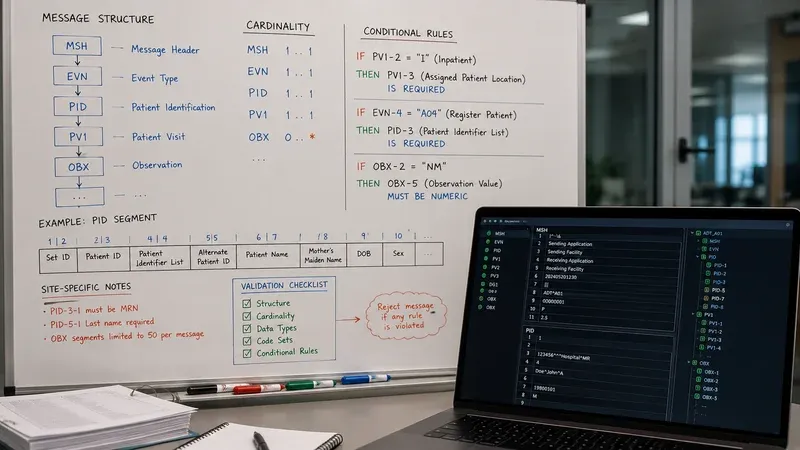
Next define segment usage. For each relevant segment, record whether it is required, optional, repeating, or prohibited in your deployment. Do not rely on the standard chapter alone if your implementation tightens the rule. If every production A08 in your environment must contain PV1, say so. If your ORU interface rejects NTE segments in a certain group, say so. Profiles exist precisely to capture those local constraints.
Then define field-level usage and predicates. Which fields are required, optional, or conditional? Under what circumstances do they become mandatory? What other fields do they depend on? Conditional logic is where most interface breakage hides because it often lives in business workflows rather than in generic parsing logic.
After that, define value constraints. That includes standard tables, local tables, and format expectations for fields that your organization treats as structured even if the standard allows looser content. If you require a local accession pattern, a specific assigning authority namespace, or a bounded list of clinic codes, the profile should say so.
Finally, document examples and non-examples. One valid sample message and one invalid sample for each high-risk scenario can do more to preserve operational intent than pages of prose. It also makes regression testing much easier when systems change.
How the HL7 Viewer Fits into Profile Work
Profiles are abstract until you apply them to real traffic. That is where the HL7 Viewer becomes indispensable. When a profile rule says "the second PID-3 repetition must be the enterprise identifier" or "the abnormal result note must follow the triggering OBX," you need to inspect the live message groupings, repetitions, field positions, and context exactly as sent. A validation report can tell you a rule failed. A structured viewer shows you why it failed and what the sender actually emitted.
That combination is especially useful during dispute resolution between teams. Instead of arguing from screenshots, reformatted engine logs, or copied text fragments, you can point to the parsed message structure and the specific profile rule side by side. That makes escalation with vendor teams and internal application owners much more efficient.
Profiles and Custom Z Segments
Conformance profiles become even more important when an interface depends on local Z segments. Standard validation can usually parse them, but it cannot know whether they are in the right place, contain the right local values, or satisfy site-specific workflow dependencies. That is why Z segments belong in the profile, not in scattered mapping notes. If your environment depends on custom segments, the companion article Validating HL7 v2 with Custom Z Segments provides a deeper framework for governing those local extensions without confusing them for the base standard.
Common Profile Patterns That Prevent Real Failures
Practical conformance profiles often center on a small number of recurring patterns. One is identifier expectations. A site may require that PID-3 always carry both a visit-scoped and enterprise-scoped identifier because downstream reconciliation depends on both. Another is status discipline. A results interface may accept ORU messages only when OBX-11 is F or C, rejecting P because preliminary values should not enter the clinical repository. Another is timing consistency, such as requiring OBR-7, OBX-14, and MSH-7 to appear together or to fall within a plausible relative sequence.
Profiles also help with group integrity. In multi-OBX result messages, the interface may require every abnormal result to carry a following NTE or may demand a local interpretation code in a companion field. In scheduling flows, the site may require SCH plus at least one resource segment of a specific class. In ADT flows, the site may require a specific combination of PID, PV1, and local bed-management data before the event can update the census system. These are not generic rules. They are site-operational rules. That is exactly why they belong in a profile.
Version Control and Ownership Matter as Much as the Rules
A profile is only useful if people know which version is current and who approves changes. Many interface environments suffer not from missing rules but from multiple contradictory rule sources. The registration team has one spreadsheet. The engine team has one transform. The receiving vendor has another PDF. The support team has a backlog of exceptions. If you want validation to be repeatable, the profile needs version control, named ownership, review history, and a change path that is as real as the code change path for the interface itself.
That ownership should include test stewardship. Whenever a field becomes newly required, a local table changes, or a Z-segment definition evolves, the corresponding profile examples and validation cases should change too. If the rule changes but the validation corpus does not, the profile becomes decorative instead of operational.
A Pragmatic Validation Workflow
- Validate the raw message against baseline HL7 rules. Use the HL7 Validator first to clear structural defects.
- Inspect the real message structure. Open the message in the HL7 Viewer to verify repetitions, groups, segment order, and contextual relationships.
- Apply profile rules explicitly. Check message type support, segment usage, field predicates, local value sets, and custom extension behavior.
- Record failures with rule citations. Every issue should point to a profile statement, not just a human opinion.
- Retest on representative scenarios. Include normal, edge, and migration-specific examples rather than a single happy-path message.
That process sounds methodical because it is. Profiles are most effective when they behave like engineering assets: versioned, cited, testable, and re-runnable.
Conclusion
HL7 syntax validity tells you a message can be processed in principle. A conformance profile tells you whether the message is safe for your interface. Mature teams use both. They start with baseline HL7 checks in the HL7 Validator, inspect real traffic in the HL7 Viewer, and encode local constraints in a profile that survives staff turnover, vendor changes, and system migrations. That extra discipline is what turns fragile interface folklore into repeatable operational quality.