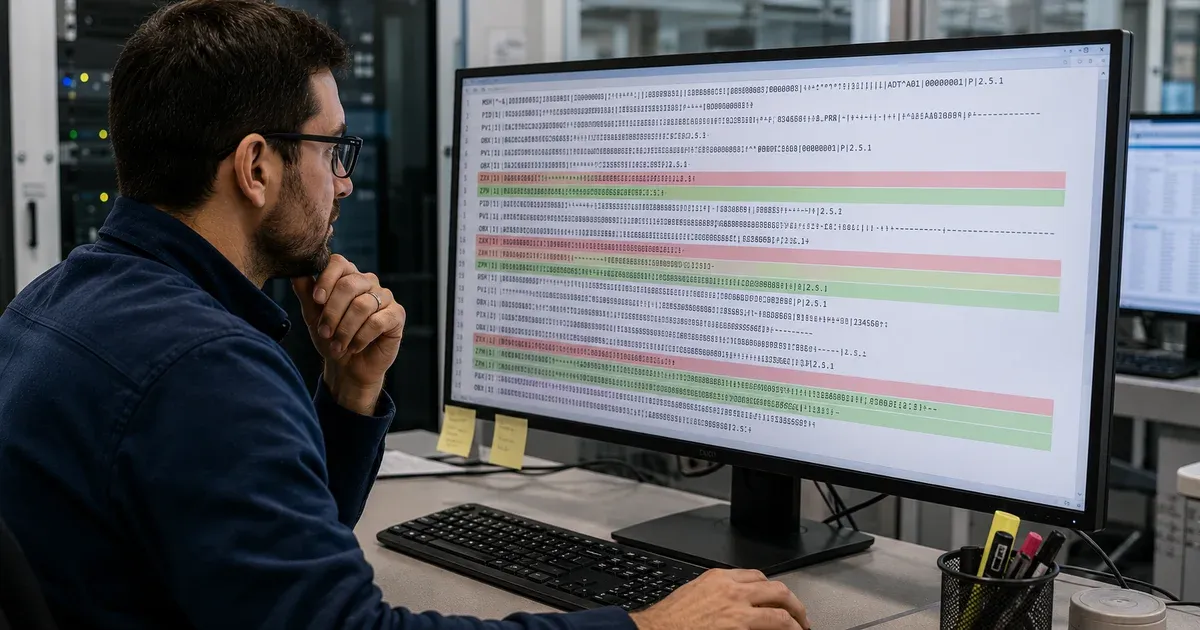
Why Custom Z Segments Need a Different Validation Mindset
Custom Z segments are one of the most normal and one of the most dangerous parts of production HL7 v2.x work. They are normal because almost every mature healthcare environment eventually extends the base standard with local fields: routing hints, visit attributes, consent flags, departmental workflow markers, financial references, device identifiers, or proprietary order qualifiers. They are dangerous because those local extensions sit outside the portable grammar that downstream receivers, vendor validators, and migration teams can rely on. If your interface process validates only the standard segments and then assumes the Z segments are someone else's problem, you create a blind spot exactly where site-specific behavior tends to be most brittle.
The right approach is layered. Start with a baseline HL7 rules check using the HL7 Validator so the message is structurally sound. Then add explicit local rules for every custom Z segment you depend on. Those layers do different jobs. The baseline validator proves the message can be parsed and that the standard skeleton is intact. The local rule set proves that the receiving site's workflow assumptions still hold. Both matter. This article explains how to build that second layer without confusing site-specific conventions for the core standard, and how to use the HL7 Segment Browser to keep your custom logic anchored to the neighboring standard segments it depends on.
Note: This article is educational technical guidance, not legal, regulatory, or vendor-specific implementation advice. Custom segment governance should always be reviewed against your local interface specifications and change-control process.
What a Z Segment Actually Is
In HL7 v2.x, any segment whose three-character identifier begins with the letter Z is reserved for local use. A hospital might define ZPV for additional visit metadata, ZRT for routing instructions, ZPI for a local payer index, or ZDS for document storage references. The standard permits this pattern specifically because HL7 v2 was designed to be adaptable to real-world workflows. The mistake teams make is assuming that because Z segments are allowed, they are self-explanatory. They are not. A custom segment is only meaningful inside the local contract that defines where it appears, which fields are required, which datatypes are expected, whether it repeats, and which downstream systems consume it.
That local contract matters more than the segment name itself. Two hospitals can both have a segment named ZIN and mean completely different things. Even inside one organization, the semantics can drift over time when a registration system changes vendors, an interface engine adds a transform, or a department introduces a new field without updating the written specification. Validation is what turns that drift into something visible.
Why Standard HL7 Validation Still Comes First
When a message contains Z segments, engineers sometimes jump directly to validating the custom content and skip the standard checks. That is backwards. A malformed MSH segment, missing required PID, invalid datatype in PV1, or broken delimiter setup will cause downstream failures regardless of how carefully the Z segment fields were populated. That is why the first pass should always be a standard rules pass in the HL7 Validator. It catches the transport-independent problems that would break any conformant receiver: invalid encoding characters, missing required segments, impossible timestamps, bad code-table values, or malformed ACK structure.
The baseline matters for another reason: it gives you a clean separation between standard defects and local defects. If a message fails because MSH-2 is wrong, that is not a Z-segment problem. If the message passes the standard layer but the receiving laboratory workflow still rejects it because ZRT-3 is empty when a certain routing code is present, that is a site-specific rule. Separating the two makes tickets clearer, escalations faster, and root cause analysis more defensible.
If you want a refresher on those baseline layers, the companion article HL7 v2.x Message Validation: A Practical Guide for Integration Engineers lays out the standard parsing, required-segment, datatype, and code-table checks in detail. Treat that article as your floor, not your finish line, whenever Z segments are involved.
The Failure Modes Teams Miss with Custom Segments
The most common Z-segment failures are not syntax errors. They are contract errors. The message parses. The standard segment set looks fine. The feed reaches production. Then a downstream workflow behaves incorrectly because a local assumption was not met. In practice, those failures tend to fall into five categories.
- Wrong placement: the Z segment is emitted before or after the wrong parent segment, so the receiver associates it with the wrong order, result, or visit occurrence.
- Silent datatype drift: a field that used to carry an NM-style numeric local code starts carrying free text, or a timestamp switches from
YYYYMMDDHHMMSSto an ISO-like format after an upstream upgrade. - Cardinality changes: a segment or field that never repeated before begins repeating, and the receiver reads only the first occurrence.
- Local table drift: a site-specific coded field gains new values, but the downstream transform or interface engine lookup table is not updated.
- Conditional rule mismatch: a Z field is required only in one workflow branch, but the sending system does not enforce the same condition as the receiver.
None of those issues are hypothetical. They are the exact defects that surface during EHR replacements, interface-engine migrations, vendor module upgrades, and cross-site rollout projects. They are also the defects most likely to evade a generic HL7 parser because the parser has no knowledge of your site's private contract.
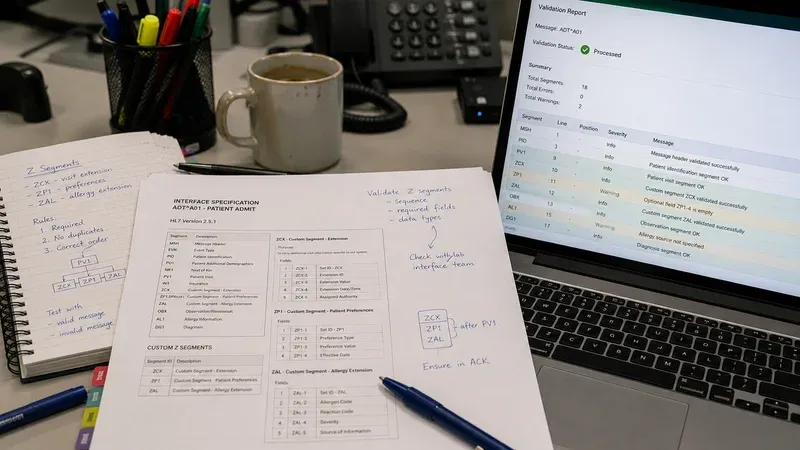
How to Design Site-Specific Validation Rules
A useful local validation rule set should answer the same kinds of questions the base standard answers for standard segments. Start with placement. If a message can contain ZPV, where is it legal? Immediately after PV1? After PV2 if PV2 exists? Once per visit group, or once per message? Placement rules prevent the downstream receiver from binding local content to the wrong context.
Next define field usage. Which Z-segment fields are required, optional, or prohibited? Do not stop at "field 1 means routing code." State whether the field may be empty, whether repetitions are allowed, and whether blank-but-present is treated the same as absent. Those distinctions matter in production engines and vendor middleware.
Then define datatype expectations. Even if a Z field is locally defined, it should still have a documented structure. If the field contains a local code and description pair, document the delimiter behavior. If it contains a date/time, document the exact format. If it contains a repeating identifier list, document which repetition separator behavior is legal. Engineers frequently write down the business meaning of a Z field and forget to write down the syntax. Validation requires both.
After that, define allowed value sets and dependencies. If ZRT-2 can only be LAB, RAD, or CARD, enforce it. If ZPI-4 becomes required only when PID-18 is populated, encode that dependency explicitly. These are the local equivalents of HL7 table and conditional usage rules, and they should be treated with the same seriousness as standard conformance checks.
Finally, define versioning behavior. Custom segments evolve, sometimes without notice. Add a version indicator somewhere in the site-specific contract, even if it is only a documented interface revision number. Without version awareness, you cannot safely validate two generations of the same feed during a phased migration.
Use the Standard Segments Around the Z Segment as Your Anchor
The easiest way to make bad local rules is to write them in isolation. Z segments make sense only in the context of the standard segments around them. A custom patient-financial segment after PID should probably inherit constraints from the encounter and account fields that follow. A custom order-routing segment after ORC or OBR should be evaluated alongside order identifiers, service codes, and status fields. A custom result qualifier near OBX should be validated against OBX-2, OBX-3, OBX-5, and OBX-11.
This is where the HL7 Segment Browser is useful even though it does not contain your local Z definitions. It lets you inspect the standard segment definitions that surround the private extension, confirm expected field datatypes and usage on the standard side, and document the dependency cleanly. If your local rule says "ZRT-4 is required when ORC-1 = NW and OBR-24 = RAD," the standard segment browser gives you the canonical reference for ORC and OBR while your local spec covers the Z fields.
The related article HL7 v2.x Segment Field Reference: A Complete Guide for Integration Engineers is also a good bridge here because it explains the standard field structures that custom extensions usually depend on. Good custom validation starts by knowing the standard context precisely.
A Practical Workflow for Messages with Z Segments
- Capture the exact raw message. Preserve the original delimiters, line endings, and sequence. Do not normalize it before validation.
- Run baseline HL7 checks first. Use the HL7 Validator to catch structural and datatype issues in the standard segments.
- Map each Z segment to its local contract. Confirm placement, required fields, datatype patterns, cardinality, and allowed values.
- Cross-check neighboring standard segments. Use the HL7 Segment Browser to verify the standard fields your custom rule depends on.
- Apply site-specific rules and record the citation. Every validation issue should point back to a written interface rule, not oral tradition.
- Retest with migration scenarios. Validate messages before and after vendor upgrades, interface-engine rewrites, and cross-site deployments to detect contract drift early.
That workflow is deliberately conservative. It treats Z-segment validation as disciplined interface engineering, not tribal knowledge. That is the posture that survives audits, go-lives, and handoffs between teams.
Example: Validating a Local Routing Segment
Imagine an ORM feed in which the sending system emits a ZRT segment after ORC. Field 1 carries a local routing destination, field 2 carries a priority code, and field 3 carries a queue identifier used by the receiving departmental system. Your site-specific contract might require:
ZRTmust appear immediately after ORC and before OBR.ZRT-1must be one ofLAB,RAD, orCARD.ZRT-2is required when ORC-1 =NWbut optional when ORC-1 =XO.ZRT-3must match the queue-format regex agreed with the downstream system.
A generic HL7 parser will not enforce any of that. A sound validation process will. That is the difference between "message parses" and "interface works." If the queue identifier changes format after a vendor patch, your custom rule should catch it before the receiving worklist silently starts dropping orders.
Profiles, Z Segments, and Long-Term Governance
As custom rules grow, handwritten spreadsheets and email threads stop being enough. That is the point where you should think in terms of a conformance profile, even if your environment never formalizes it with a national implementation guide. A profile makes the local contract explicit: message structure, usage, predicates, local value sets, and workflow-specific conditions. The related article HL7 Conformance Profiles and Site-Specific Validation covers that transition in detail and explains when a site should move from ad-hoc local rule lists to full profile-aware validation.
Governance is what keeps private extensions from becoming private liabilities. Every Z segment should have an owner, a specification, an approved change path, example messages, and regression tests. If no one can answer who owns ZPV-6 or whether it is still required, you do not have a validation problem. You have a governance problem that validation is merely exposing.
Conclusion
Custom Z segments are not a reason to abandon HL7 validation. They are a reason to take validation more seriously. Use the HL7 Validator to prove the base HL7 message is sound. Use the HL7 Segment Browser and your written site specification to prove the local extension is sound. Tie every custom rule to a documented contract. Re-run those checks during every migration, interface change, and vendor upgrade. The teams that do this systematically treat Z segments as governed interface assets. The teams that do not eventually discover that their most critical workflow depends on undocumented behavior no one can safely change.